If payroll outcomes cannot be explained, they cannot be governed.
Most organisations can detect payroll errors. Far fewer can explain why they occurred, how far they extend, or whether they have been resolved in a consistent way.
That gap matters because payroll issues rarely stay contained within operations. Directors in Australia now carry personal liability for payroll compliance failures in a way they did not a decade ago.
Looking at the gap between detection and control of payroll errors, this blogpost explores what sits behind it and what it takes to close it.
The governance challenge
Payroll outcomes are not driven by a single failure point. They are shaped by system configuration, award interpretation, time and attendance inputs, and decisions made across teams over time.
When an issue is identified, whether through an audit, complaint or regulator enquiry, the cause rarely sits in one place.
For example, a weekend underpayment might look like a simple error. But in practice it could come from:
- An award rule being interpreted incorrectly
- A pay code mapped incorrectly in the system
- Timesheet inputs not aligning with how the rule is applied
- Similar roles being treated slightly differently across teams
- Non compliant or inefficient rostering
In most cases, it is a combination.
That is what makes payroll issues difficult to govern. They span systems, time periods and business functions, and the impact is rarely isolated to one employee or one pay run.
This creates a visibility gap, often driven by:
- Fragmented data that makes it hard to trace outcomes end to end
- Inconsistent interpretations that lead to different conclusions
- Limited ability to quantify impact across the workforce
- Remediation approaches that are manual and not repeatable
- Siloed business functions
The result is predictable where decisions are made on partial information, issues are fixed locally but continue elsewhere and the same underlying drivers remain in place.
From detection to control
Effective governance requires more than identifying errors. It requires understanding patterns.
Instead of looking at issues one by one, organisations need to be able to step back and answer a clearer set of questions:
- How many employees are impacted?
- Over what time period?
- What the total financial exposure is?
- What is actually driving the issue?
Without that, remediation and an ongoing compliance approach stays reactive. With it, decisions become consistent.
At a practical level, this means having a structured way to:
- Quantify impact across employee cohorts, time periods and issue types
- Identify recurring payroll issue causes across employees, locations and pay types
- Link issues back to the underlying obligation, such as an award clause or agreement term
- Prioritise action based on risk
Governance that stands up to scrutiny
Boards do not need to understand every payroll rule. But they do need to know whether payroll risk is understood and controlled.
That comes down to evidence:
- Can the organisation explain why issues occurred?
- Can it show where else those issues exist?
- Can it demonstrate that fixes are applied consistently?
Without that level of visibility, governance remains incomplete and confidence becomes difficult to support.
Root cause analysis is what connects detection to control and allows organisations to move from fixing payroll issues to managing payroll risk. It provides a structured way to understand not just what went wrong, but why it happened, where else it may exist, and what action will prevent it from recurring.
For boards, the question is not whether issues exist, but whether there are enough visibility and evidence to stand behind how they are being managed. That requires equipping management teams with the tools and insight to demonstrate control, not just assume it.
Introducing AI-powered Detailed Root Cause Analysis feature
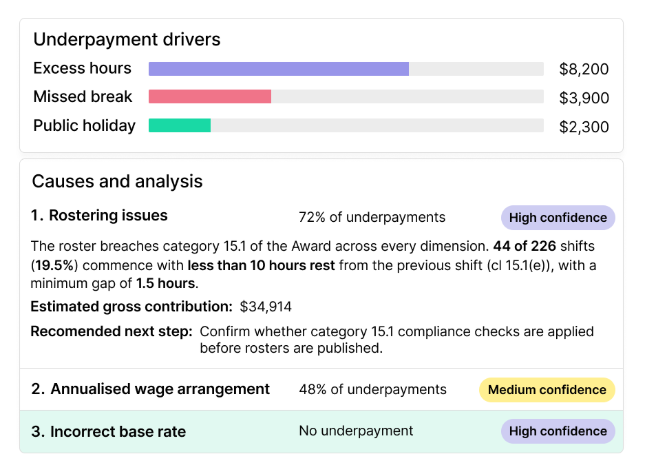
Yellow Canary’s AI powered Root Cause Analysis capability brings structure to how payroll issues are understood and managed.
It supports both remediation and ongoing payroll compliance by providing clear, evidence-based and actionable insight into payroll outcomes.
Teams can:
- Analyse underpayments and overpayments in detail
- Link issues to obligations such as award clauses, payroll data, process gaps and system configuration
- Identify what requires immediate action and what can be monitored
- Assign clear actions to each issue
Available in beta: Test the AI powered capability today.
Fill in the form and note ‘Root Cause Analysis’ within ‘Additional information’.



.webp)